
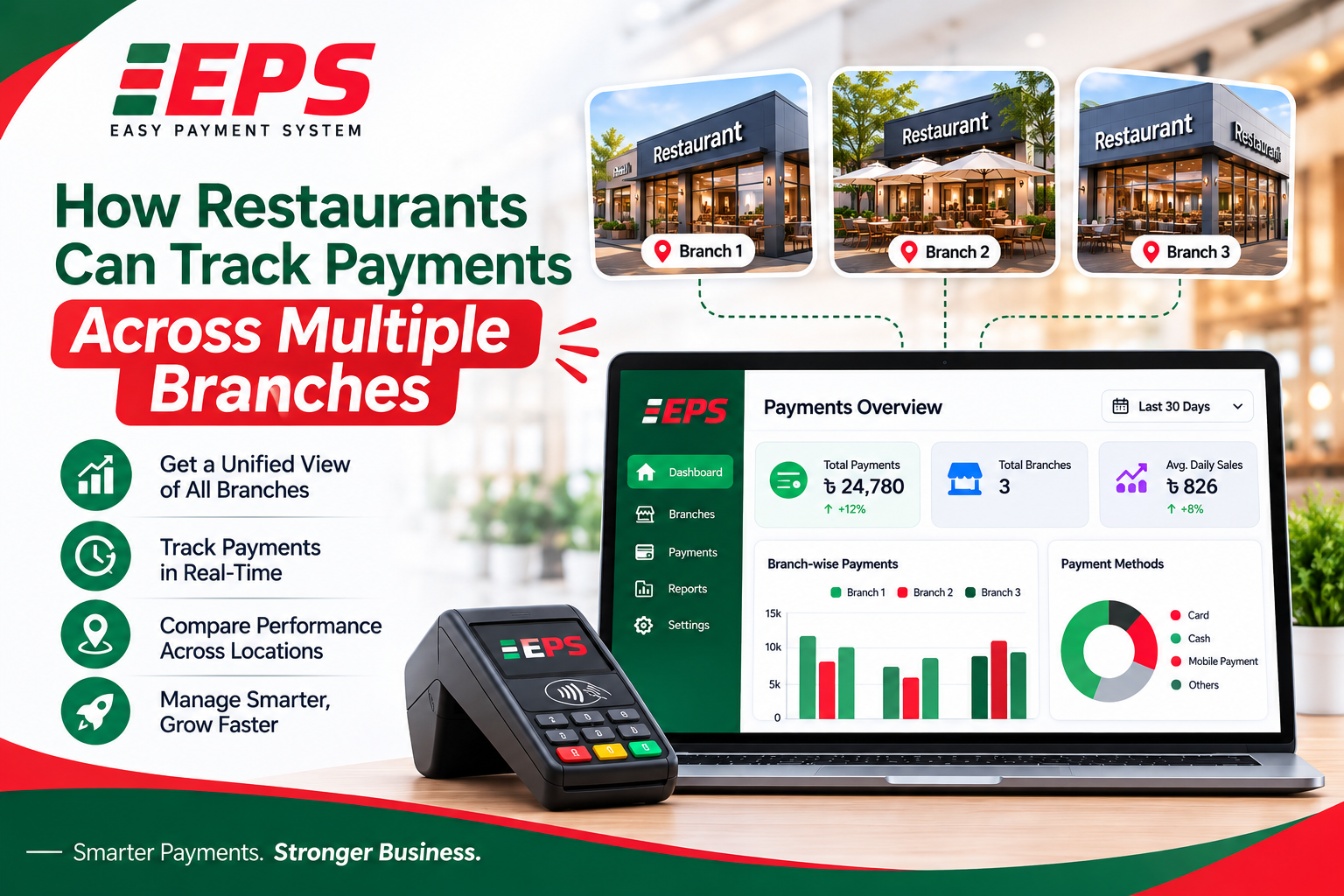
Running a restaurant with several branches means managing more than food quality, staff schedules and customer service. Every location receives payments through different channels, handles refunds, processes discounts and records daily sales. When these activities are managed separately, owners may struggle to understand how much money each branch has collected and whether the recorded sales match the actual settlements.
A central payment tracking process gives restaurant owners a clearer view of transactions across all locations. It helps finance teams compare branch performance, identify missing payments, review refunds and prepare accurate financial reports. Using an online payment gateway in Bangladesh can support this process by bringing digital payment records into a more organised system.
Why Multi-Branch Restaurants Need Centralised Payment Tracking
A single restaurant may manage its daily payments through cash, cards, mobile financial services, online orders and food delivery platforms. A restaurant chain has to manage these activities across several locations, often with different managers and payment procedures.
For example, a restaurant group with five branches may receive payments through bKash, Nagad, Visa, Mastercard and cash. If each branch maintains separate spreadsheets or handwritten records, the head office must collect and compare multiple reports before preparing a consolidated statement.
This creates several operational challenges:
- Different branches may follow different reporting formats.
- Transactions can be recorded twice or missed during manual entry.
- Refunds and cancelled orders may not appear in the same report as sales.
- Finance teams may spend hours collecting daily figures.
- Owners may not notice unusual payment patterns until the monthly accounts are prepared.
Centralised payment tracking allows management to review branch-level transactions while keeping the overall business report in one place.
1. Assign a Unique Branch ID to Every Location
The first step is to identify every restaurant branch separately within the payment and accounting system. Each location should have a unique branch ID or merchant location code.
For example, a restaurant chain operating in Dhaka, Chattogram and Sylhet could use the following structure:
|
Branch |
Branch ID |
Location |
|
Dhanmondi |
RST-001 |
Dhaka |
|
Gulshan |
RST-002 |
Dhaka |
|
Uttara |
RST-003 |
Dhaka |
|
Agrabad |
RST-004 |
Chattogram |
|
Zindabazar |
RST-005 |
Sylhet |
Every payment record should carry the relevant branch identifier. This allows the finance team to identify where a transaction originated without checking with the restaurant manager.
The same structure should be used in POS software, online ordering systems, payment links and accounting records wherever the systems support it. A consistent branch code also helps prevent confusion when two locations have similar sales amounts or transaction references.
2. Bring Digital Payment Records Into One Dashboard
Restaurant owners should be able to review transactions from all branches without requesting separate reports from every location. A central dashboard can provide this view by collecting payment information from connected systems.
A useful dashboard should show:
- Total transactions across all branches
- Successful, pending and failed payments
- Payment amounts by branch
- Transactions grouped by payment method
- Refunds and cancelled payments
- Settlement status and payment history
The dashboard should also allow users to filter records by date, branch, transaction status and payment channel.
A 2024 TouchBistro report on multi-unit restaurants found that 76% of surveyed multi-unit operators used cloud POS systems, while 67% used integrated payment processing alongside their POS. These figures describe the surveyed US restaurant market, not Bangladesh, but they show why connected systems are receiving attention among restaurant groups.
For a restaurant chain, a shared dashboard reduces the need to collect separate payment files before reviewing business performance.
3. Track Payments by Branch and Payment Method
Total sales alone do not provide enough information for financial monitoring. Restaurant management should also understand how customers pay at each location.
One branch may receive a larger share of card payments, while another may depend more on mobile financial services. Online orders may also account for a different share of revenue at each location.
A branch-wise payment report can include:
|
Payment Method |
Branch A |
Branch B |
Branch C |
|
Cash |
৳45,000 |
৳38,000 |
৳42,000 |
|
Mobile banking |
৳32,000 |
৳28,000 |
৳35,000 |
|
Cards |
৳25,000 |
৳31,000 |
৳22,000 |
|
Online orders |
৳18,000 |
৳21,000 |
৳16,000 |
|
Total |
৳120,000 |
৳118,000 |
৳115,000 |
Illustrative figures for a daily branch report.
This report helps managers understand payment preferences and identify locations where a particular payment channel is used more frequently. It also helps the finance team compare recorded transactions with the amounts received through banks and payment providers.
When selecting a system, restaurants should check whether it supports the payment gateway service provider in Bangladesh requirements of their business, including transaction reporting, payment channel coverage, settlement information and technical integration.
4. Reconcile Daily Sales With Actual Settlements
Payment reconciliation is the process of comparing restaurant sales records with payment transaction records and the amounts received in the bank account.
This step is necessary because a successful customer payment and a completed bank settlement are two different stages. A transaction may be successful while the related settlement is still being processed. Refunds, cancellations, processing charges and other adjustments can also create differences between gross sales and the amount deposited.
A daily reconciliation process should follow these steps:
Step 1: Collect branch sales records
Download the daily POS report from each restaurant location. The report should include order IDs, transaction amounts, discounts, refunds and payment methods.
Step 2: Collect payment transaction reports
Retrieve the payment records from the relevant banks, wallets and payment gateway dashboard.
Step 3: Match transaction references
Compare order IDs, transaction IDs, payment amounts and timestamps. Each successful digital payment should match a corresponding restaurant order.
Step 4: Review unmatched transactions
Check failed payments, duplicate entries, pending transactions, refunds and payments that do not match the POS records.
Step 5: Verify settlement amounts
Compare the settlement report with the amount credited to the restaurant's bank account. Record any differences for follow-up.
A restaurant group should assign responsibility for reconciliation to a finance team member. Branch managers can confirm sales and refund records, while the central accounts team reviews the consolidated figures.
5. Monitor Refunds, Discounts and Cancelled Orders
Refunds and discounts need separate attention because they affect the final revenue figures of each branch.
For example, a customer may pay ৳2,000 for an order and later receive a ৳500 partial refund. If the restaurant records only the original payment, its sales report will not reflect the amount returned to the customer.
Every branch should maintain a record of:
- Original transaction ID
- Order number and branch ID
- Refund amount
- Refund date
- Reason for the refund
- Staff member who approved the refund
- Current refund status
Discounts should also be recorded separately from refunds. A promotional discount reduces the amount charged to the customer, while a refund returns money after a payment has been made.
These records help management identify repeated billing errors, unusual refund activity and differences in discount practices between branches.
6. Set Daily, Weekly and Monthly Reporting Schedules
A central payment system becomes more useful when the restaurant follows a fixed reporting schedule. Different reports serve different management needs.
|
Report |
Frequency |
Main Purpose |
|
Branch transaction report |
Daily |
Review collected payments |
|
Settlement report |
Daily |
Check received and pending funds |
|
Refund report |
Daily |
Review returned payments |
|
Branch comparison report |
Weekly |
Compare sales and payment trends |
|
Consolidated financial report |
Monthly |
Support accounts and business planning |
Daily reports help identify transaction issues before they remain unresolved for several days. Weekly reports give management a chance to compare branch performance, while monthly reports support accounting and financial review.
Restaurant owners should also set reporting cut-off times. For example, all branches may submit their daily sales records by 11:00 AM on the following business day. A fixed deadline helps the central accounts team complete reconciliation without waiting for individual managers.
7. Connect POS Software, Online Ordering and Payment Systems
Restaurants often use separate software for billing, inventory, online orders and payment collection. If these systems do not exchange information, staff may need to enter the same transaction details more than once.
Connecting the POS or ordering platform with the payment system can reduce repeated data entry. When a customer pays online, the system should record the payment status against the relevant order. The transaction reference should also be available for later reconciliation.
Before choosing an integration, restaurant owners should check:
- Whether the payment system supports API integration
- Whether branch or outlet identifiers can be passed with transactions
- Whether payment confirmations can return to the POS
- Whether reports can be exported for accounting
- Whether user permissions can be assigned by role
- Whether technical support is available when an integration issue occurs
EPS provides restaurant payment gateway solutions in Bangladesh for restaurants, cafes and food chains. Its listed services include digital payment collection, multiple payment methods, transaction reporting, order tracking and API integration with restaurant systems.
8. Choose Payment Methods That Match Customer Preferences
A restaurant chain should review the payment channels customers use at different branches. Some customers prefer mobile banking, while others use debit or credit cards. Online ordering customers may expect to pay through a digital checkout rather than at the counter.
The supported online payment methods in Bangladesh include mobile financial services, cards and internet banking. Restaurants should review the available channels and select those suitable for their customers and business model.
When comparing providers, restaurant owners may search for the best payment gateway Bangladesh businesses can use. The decision should be based on transaction reporting, settlement processes, security, integration requirements, customer support and pricing—not only the transaction charge.
Restaurants serving overseas customers or accepting payments from international platforms may also need to ask whether an international payment gateway in Bangladesh can support their particular collection requirements. Availability and approval depend on the provider's supported services and merchant arrangements.
9. Protect Payment Records With Access Controls
Not every employee needs access to every financial report. Branch managers may need to view transactions from their own locations, while the head office finance team may require access to consolidated reports.
A role-based access structure can help protect business records. For example:
- Cashiers can view payment status for their assigned orders.
- Branch managers can review transactions and refunds for their locations.
- Finance staff can access settlement and reconciliation reports.
- Head office administrators can review all branches.
Restaurants should also use strong passwords, review account access when employees leave and keep records of refunds or manual adjustments. Payment data should be handled according to the provider's security requirements and the restaurant's internal policies.
Build a Clear Payment Tracking Process With EPS Bangladesh
Managing payments across multiple branches requires consistent transaction records, branch-level reporting and regular reconciliation. Restaurants that rely on separate spreadsheets and manual reports may find it difficult to identify payment differences or prepare consolidated accounts.
EPS Bangladesh provides digital payment services for businesses, including restaurant payment collection, supported digital payment channels, transaction tracking and settlement information. Restaurants can review the available services and discuss their integration requirements based on their existing POS, website or ordering system.
Visit EPS Bangladesh to learn about its payment services and discuss a payment setup for your restaurant business. A well-planned payment tracking process can help your team review branch transactions with greater clarity and keep financial records organised as the restaurant chain grows.