
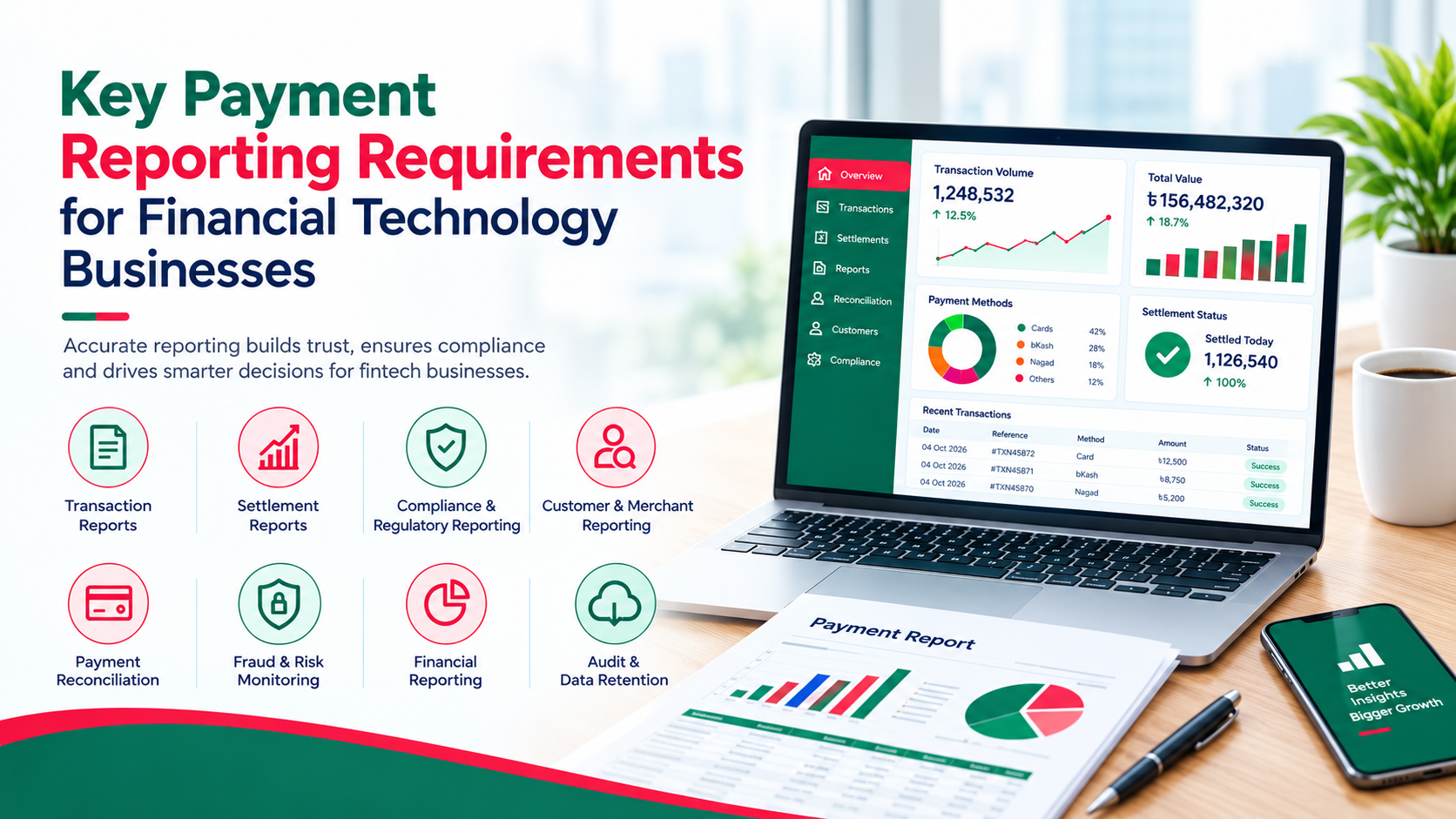
Payment reporting is a core part of financial technology operations. Every digital transaction creates information that a business may need to review, verify, reconcile or present during an audit. For fintech companies, accurate reporting helps finance teams understand transaction activity, identify payment issues and maintain clear financial records.
A payment report should do more than show how much money entered or left an account. It should explain the transaction date, payment channel, amount, status, fees, settlement details and any related adjustments. Businesses using an online payment gateway in Bangladesh need to consider how payment information moves between customers, merchants, banks and payment service platforms.
Reporting requirements vary according to a company's licence, services, business model, transaction channels and applicable regulatory obligations. A payment service provider, digital wallet operator, payment gateway, lending platform and fintech software company may not all have the same reporting duties. Each business should identify the rules that apply to its activities before setting up its reporting process.
Why Payment Reporting Matters for Fintech Businesses
Fintech companies often process transactions through several channels. A single business may accept card payments, mobile financial service payments, bank transfers, QR payments and other digital payment options. Without consistent reporting, finance teams may struggle to match transaction records with bank statements and settlement information.
A structured reporting process helps businesses:
- Track incoming and outgoing transactions.
- Identify pending, failed, reversed and refunded payments.
- Compare transaction values with settlement amounts.
- Review service charges and other deductions.
- Prepare records for internal checks and external audits.
- Respond to customer and merchant payment queries.
For example, a fintech company processing 20,000 transactions in a month needs more than a monthly sales total. Its finance team may need transaction-level records to investigate a disputed payment, confirm a refund or explain a difference between the gross transaction value and the amount received after fees.
1. Transaction-Level Reporting
Transaction-level reporting is the foundation of payment records. Each payment should have a unique reference number so that the finance team can identify it without relying only on customer names or payment dates.
A standard transaction report should contain:
- Transaction ID and order or invoice reference.
- Date and time of payment.
- Transaction amount and currency.
- Payment channel and payment status.
- Merchant or customer reference.
- Applicable fees, charges and taxes.
- Refund, reversal or adjustment details, where relevant.
Payment status needs particular attention. A transaction marked as initiated is not necessarily completed. Similarly, a pending transaction should not be treated as settled revenue until its final status has been confirmed.
Fintech businesses should maintain records of successful, failed, cancelled, pending and reversed transactions. This distinction helps prevent incorrect financial totals and reduces confusion when customers contact the support team.
2. Settlement and Reconciliation Reports
Transaction reporting and settlement reporting serve different purposes. A transaction report shows what customers attempted or completed through a payment channel. A settlement report shows how much money was transferred to the relevant merchant or business account.
Finance teams should compare the following information:
- Total successful transaction value.
- Refunds and reversed payments.
- Payment processing charges.
- Other applicable deductions.
- Net settlement amount.
- Actual bank credit and settlement date.
Consider a fintech platform that records BDT 500,000 in successful payments during a reporting period. If BDT 15,000 is refunded and BDT 5,000 is deducted in service charges, the expected net settlement would be BDT 480,000, assuming there are no other adjustments.
A reconciliation report should explain each difference between the expected and actual settlement. It should also identify transactions that remain unsettled beyond the normal processing period.
Businesses looking for payment gateway service provider in Bangladesh can review the provider's reporting facilities, settlement process and transaction information before making a decision.
3. Customer Verification and KYC Records
Know Your Customer (KYC) records help financial businesses establish who is using their services. Customer verification is particularly relevant to regulated fintech operations, digital wallets and payment services that maintain customer accounts or process financial transactions.
Depending on the business model and applicable rules, records may include:
- Customer identity and contact information.
- National identity or other accepted identification details.
- Business registration and ownership information for merchants.
- Verification date and verification status.
- Risk classification and review history.
- Records of changes to customer information.
KYC reporting should also show whether required verification steps have been completed. If a customer or merchant has not completed a required verification process, the system should make that status visible to authorised employees.
Fintech companies should restrict access to sensitive customer information. Reports shared with management or external reviewers should contain only the information required for their purpose.
4. AML and Suspicious Transaction Reporting
Anti-Money Laundering (AML) and Counter-Terrorist Financing (CFT) obligations are relevant to regulated financial businesses. Payment records can help compliance teams identify unusual transaction patterns, review customer activity and investigate potential financial crime.
Examples of activity that may require review include:
- Repeated transactions that do not match a customer's normal activity.
- Unusual transaction amounts or frequency.
- Multiple transactions that appear to be structured to avoid attention.
- Payments involving unexpected accounts or counterparties.
- Attempts to use incomplete or inconsistent customer information.
A suspicious transaction report is not the same as an ordinary payment report. It requires a separate review and reporting process under the applicable regulatory instructions. Businesses should maintain internal procedures for identifying, escalating and documenting suspicious activity.
In Bangladesh, the Bangladesh Financial Intelligence Unit (BFIU) receives suspicious transaction and suspicious activity reports from reporting organisations. It also issues guidance and supervises compliance with relevant anti-money laundering requirements. The reporting duties depend on the organisation's status and applicable rules.
5. Trust Account, Settlement Account and Liability Reporting
For relevant licensed payment service providers, reporting may extend beyond individual customer transactions. Businesses may also need to maintain information about customer funds, settlement accounts, e-money balances and merchant liabilities.
These records help show whether the funds and liabilities recorded in the payment system agree with the balances held through the relevant banking arrangements.
A reporting framework may include:
- Trust and settlement account balances.
- Funds received but not yet settled.
- Merchant balances and outstanding liabilities.
- E-money balances, where applicable.
- Transfers, adjustments and investment information where permitted.
- Differences between recorded liabilities and available funds.
Bangladesh Bank issued a reporting direction in January 2026 covering daily information on trust and settlement accounts, funds in transit, investments from trust accounts and e-money or merchant liabilities for specified licensed entities. The direction also set a monthly submission deadline using a designated reporting format. Businesses within its scope should review the actual circular and subsequent instructions before setting their reporting calendar.
6. Financial Statements and Audit Reports
Payment reporting should connect with the company's accounting records. Finance teams need to make sure that payment income, service charges, refunds, operating expenses and outstanding balances are reflected correctly in financial statements.
Common financial reports include:
- Daily and monthly transaction summaries.
- Revenue and service charge reports.
- Settlement and bank reconciliation statements.
- Refund and chargeback summaries.
- Outstanding merchant and customer balances.
- Financial statements and supporting schedules.
For licensed Payment System Operators (PSOs) and Payment Service Providers (PSPs), applicable reporting and disclosure obligations should be checked against Bangladesh Bank's current regulations and licence conditions. The Bangladesh Payment and Settlement Systems Regulations include annual reporting and audited financial statement provisions for licensed PSOs and PSPs.
An audit-ready record should show where each figure came from. Finance teams should be able to trace a reported amount back to the original transaction, settlement entry, bank statement or adjustment record.
7. Failed Payments, Refunds and Dispute Reports
Failed payments and disputes require their own reporting process. A fintech company may record a payment as unsuccessful even though the customer sees a debit notification from their bank or wallet. Such cases need investigation and a clear record of the final outcome.
A dispute report should include:
- Transaction reference and date.
- Customer or merchant complaint details.
- Payment channel and reported issue.
- Investigation status.
- Refund or reversal information.
- Resolution date and responsible team.
Regular review of these reports can help management identify recurring issues with a particular payment channel, bank connection or technical process.
8. Operational and Risk Reporting
Payment reporting also covers incidents that affect the availability, security or reliability of payment services. Fintech companies should document service interruptions, system errors, security incidents and other operational issues according to their internal policies and applicable regulatory instructions.
Useful operational reports may cover:
- Payment service downtime and affected channels.
- Failed transaction rates.
- Delayed settlement cases.
- Unusual system activity.
- Security incidents and investigation records.
- Corrective actions and incident closure dates.
For example, if a technical interruption affects 800 payment attempts, the company should record the time of the incident, affected services, transaction outcomes and steps taken to resolve the issue. This information helps management assess operational risks and respond to future incidents.
How Fintech Companies Can Improve Their Reporting Process
A reporting process needs clear ownership, consistent data and regular review. Companies should avoid depending on separate spreadsheets maintained by different departments without a common reporting standard.
The following practices can help:
- Set a reporting schedule: Decide which reports are required daily, weekly, monthly, quarterly or annually. Match submission dates with applicable regulatory deadlines.
- Use consistent transaction references: Maintain unique IDs across payment, settlement, refund and accounting records.
- Assign reporting responsibilities: Define which teams prepare, review and approve each report. Finance, compliance, operations and technology teams may have different responsibilities.
- Keep an audit trail: Record report preparation dates, changes, approvals and supporting documents.
- Review data quality: Check missing transaction IDs, duplicate entries, incorrect amounts and inconsistent payment statuses before submitting reports.
- Protect sensitive information: Apply access controls and secure storage for customer, merchant and transaction records.
Choosing Payment Technology With Reporting Requirements in Mind
A payment platform should do more than process customer transactions. Fintech businesses need access to clear payment records that support daily accounting, settlement checks and financial reviews. Before selecting a provider, companies should assess transaction reporting, refund records, settlement details and data access for authorised employees.
When comparing the Fintech Payment Gateway Solutions in Bangladesh, businesses should check whether the available reporting features match their transaction volume, payment channels and internal accounting requirements.
The platform should also fit the company's existing financial processes. Clear transaction references, downloadable reports and reliable settlement information can help finance teams investigate discrepancies and prepare records for audits. A payment solution should support these tasks while meeting the business's security and compliance requirements.
Conclusion
Payment reporting gives fintech businesses a record of what happened at each stage of a financial transaction. From transaction details and settlement statements to customer verification, suspicious activity and audit records, each report serves a specific purpose.
For fintech companies in Bangladesh, the reporting process should reflect the services they provide and the regulatory obligations that apply to them. Clear reporting responsibilities, accurate transaction data, regular reconciliation and secure record-keeping can help finance and compliance teams maintain better control over payment operations.
EPS Bangladesh provides payment solutions for businesses that need digital payment facilities. Fintech companies can review its services and discuss their business requirements at EPS Bangladesh.